
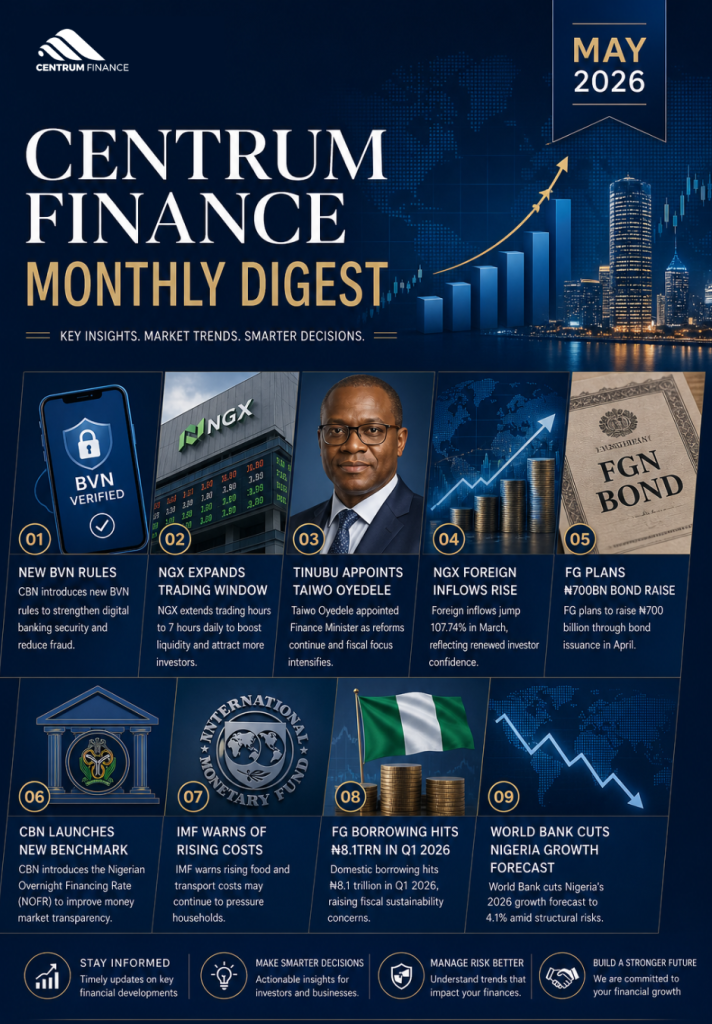
Contents
-
New BVN Rules
-
NGX expands trading window to 7hrs
-
Tinubu appoints Taiwo Oyedele as Finance Minister
-
NGX Foreign Inflows Rise
-
FG Plans N700bn Bond Raise
-
CBN Launches New Benchmark
-
IMF Warns of Rising Costs
-
FG Borrowing Hits N8.1trn in Q1 2026
-
World Bank Cuts Nigeria Growth Forecast
The New BVN Rules and What to Know About It

CBN Tightens Digital Banking Security with New BVN Framework
The Central Bank of Nigeria (CBN) has introduced sweeping changes to the Bank Verification Number (BVN) system, set to take effect from May 1, in a move aimed at strengthening digital banking security and reducing fraud across the financial system.
These new guidelines will significantly change how millions of Nigerians access mobile banking, manage their accounts, and interact with financial platforms, especially as digital banking adoption continues to grow rapidly. Here are a few things to note about the new policy:
- Stricter Device Access
Under the new framework, customers will only be allowed to operate their banking apps on one mobile device at a time. Once a user logs into a new phone, they will automatically be logged out from any previously connected device. In addition, switching devices will now require an extra layer of verification, a measure designed to prevent unauthorized access and protect users from identity theft and account breaches.
- Enhanced Fraud Monitoring
The CBN is also strengthening its fraud detection systems. BVNs flagged for suspicious or unusual transactions will be placed under a 24-hour watchlist, during which banks may temporarily restrict or freeze associated accounts pending further investigation. This move is aimed at proactively identifying and stopping fraudulent activities before significant financial losses occur.
- Limits on Phone Number Changes
A major update affects how customers manage their registered phone numbers. Under the new rules, individuals will only be allowed to change their BVN-linked phone number once, reducing the risk of SIM-swap fraud, which has become increasingly common in Nigeria’s banking space.
- New Eligibility Guidelines
The updated framework also introduces stricter rules for account ownership. Only individuals aged 18 and above will be eligible to register for a BVN independently, while minors must operate accounts under the supervision of a parent or guardian.
- Transaction Limits After Device Switch
Customers who log into their banking apps on a new device will face temporary transaction restrictions. For the first 24 hours, transfers will be capped at ₦20,000, providing an additional layer of protection against unauthorized transactions during device changes.
According to the CBN, these changes are part of broader efforts to strengthen the integrity of Nigeria’s financial system, improve customer protection, and address the rising threat of cybercrime.
While the measures may introduce minor inconveniences for users, they represent a necessary step toward creating a safer and more secure digital banking environment.
Customers are advised to familiarize themselves with these updates ahead of implementation to avoid disruptions and ensure a smooth banking experience.
NGX Expands Trading Window to 7hrs

The Nigerian Exchange Limited (NGX) has expanded its daily trading window from 4.5 hours to 7 hours, effective Monday, 27 April 2026. Under the revised schedule, market activities will now run from 9:00 a.m. to 4:00 p.m. WAT, compared to the previous trading hours of 9:30 a.m. to 2:00 p.m.
Approved by the Securities and Exchange Commission (SEC), the adjustment is aimed at deepening market liquidity, improving price discovery, and broadening access for both domestic and international investors. According to NGX, the longer trading session will provide greater flexibility for market participants, enhance responsiveness to market-moving information, and encourage wider participation across the market.
The development comes on the heels of Nigeria’s recent reclassification to Frontier Market status by FTSE Russell, further strengthening the Exchange’s global profile and attractiveness to foreign investors.
NGX noted that the implementation followed extensive stakeholder engagement to ensure operational readiness ahead of the launch date. NGX Regulation Limited will continue to provide oversight to ensure a smooth transition while maintaining high standards of transparency and investor protection.
Overall, the reform represents another positive step in the continued development of Nigeria’s capital market, positioning NGX as a more competitive and accessible multi-asset exchange while supporting efficient capital formation.
Tinubu Appoints Taiwo Oyedele as Finance Minister

President Bola Tinubu has appointed Taiwo Oyedele, former head of the Presidential Committee on Fiscal Policy and Tax Reforms, as Minister of Finance, succeeding Wale Edun in one of the most notable changes to Nigeria’s economic team.
The reshuffle comes at a critical period for the Nigerian economy, shortly after the International Monetary Fund (IMF) and global policymakers reviewed conditions across emerging markets at the recent Washington meetings. While the IMF acknowledged progress made through Nigeria’s reform programme, it also highlighted the importance of debt sustainability and repayment capacity amid tighter global financial conditions.
Nigeria’s total public debt rose to ₦159.28 trillion (US$110.97 billion) as of December 31, 2025, according to Debt Management Office figures. Domestic debt accounted for ₦84.85 trillion, while external debt stood at ₦74.43 trillion, representing nearly 47% of the total debt stock. External obligations remain particularly significant given ongoing pressure on foreign exchange liquidity and rising debt service costs.
Oyedele assumes office as the administration continues implementing market-oriented reforms and efforts to expand non-oil revenue. These measures have been positively received by investors and development institutions as necessary steps toward improving fiscal sustainability and attracting capital inflows.
However, the reforms have also created near-term pressures for households, with higher fuel prices, naira depreciation, and elevated food and transport inflation contributing to a broader cost-of-living challenge.
The key focus in the near term will be whether the leadership change signals any shift in policy direction. Current expectations suggest continuity in the government’s broader reform agenda, with renewed emphasis on faster execution, stronger revenue mobilisation, and clearer economic gains.
NGX Foreign Inflows Rise
Foreign Investors Return as NGX Records Sharp Inflow Surge
Foreign portfolio investment in Nigeria’s capital market recorded a strong rebound in March 2026, with total foreign transactions on the Nigerian Exchange (NGX) rising sharply by 107.74 per cent to N288.82 billion, according to the latest data released by NGX Regulation Limited.
The surge reflects renewed confidence among international investors, driven largely by improved foreign exchange liquidity and recent market re-ratings that have made Nigerian equities more attractive. Foreign inflows alone increased significantly from N72.32 billion in February to N181.77 billion in March, highlighting a notable shift in investor sentiment after months of cautious participation.
Overall market activity also strengthened during the period, as total transactions climbed by 13.10 per cent to N1.744 trillion, up from N1.542 trillion recorded in February. The increase points to growing engagement across the market, supported by both domestic and foreign investors responding to improving macroeconomic conditions.
Despite the strong rebound in foreign participation, domestic investors continued to dominate trading on the Exchange, accounting for 83.44 per cent of total transactions, with a combined value of N1.455 trillion. Institutional investors, including pension funds and asset managers, maintained a leading role, significantly outperforming retail investors and reinforcing their position as the backbone of the Nigerian capital market.
Market analysts attribute the renewed foreign interest to ongoing fiscal and monetary reforms aimed at stabilising the naira and improving transparency within the foreign exchange market. Historically, foreign participation in Nigeria’s equities market has been constrained by currency volatility and challenges associated with repatriating funds. However, recent improvements in the Nigerian Autonomous Foreign Exchange Market appear to be restoring confidence among global investors.
On a broader scale, the market has continued to show strong growth in 2026. Year-to-date figures indicate that total transactions for the first quarter reached N4.148 trillion, representing an 85.87 per cent increase compared to N2.232 trillion recorded during the same period in 2025. This performance reflects a sustained rally in the equities market, with the NGX All-Share Index reaching record highs over the past year.
Over the long term, domestic participation has continued to expand significantly, rising by more than 160 per cent over the past 19 years, further strengthening the depth and resilience of the market. While foreign participation has historically been more volatile, the recent rebound suggests a gradual return of international capital.
As the second quarter begins, market observers expect institutional investors to maintain their strong presence, while foreign participation is likely to remain sensitive to key macroeconomic indicators, particularly inflation trends and interest rate decisions by the Central Bank of Nigeria.
FG Plans N700bn Bond Raise

The Federal Government is set to raise N700 billion from the domestic bond market in April 2026, as it continues to adjust its borrowing strategy in response to rising interest rates and increasing debt servicing costs.
According to details from the April 2026 Bond Offer Circular issued by the Debt Management Office (DMO), the bond auction is scheduled for April 27, with settlement expected on April 29. The issuance will be carried out through the re-opening of existing bonds across three maturities, a move aimed at improving liquidity in benchmark securities rather than introducing entirely new instruments.
The offer includes N300 billion of the 17.945 per cent FGN August 2030 bond, N100 billion of the 17.95 per cent FGN June 2032 bond, and N300 billion of the 22.60 per cent FGN January 2035 bond. The bonds will be issued in units of N1,000, with a minimum subscription of N50.001 million, indicating a clear focus on institutional investors such as pension funds, banks, and asset managers.
The instruments are also structured to remain attractive to investors, as they qualify as liquid assets for banks and are exempt from certain taxes under existing laws. These features have continued to support strong demand for government securities, even in a challenging macroeconomic environment.
The April issuance represents a continuation of the government’s gradual reduction in monthly borrowing. Bond offers have steadily declined from N900 billion in January to N800 billion in February, N750 billion in March, and now N700 billion in April, suggesting a measured adjustment rather than a significant shift in overall borrowing strategy.
In March, the government offered a total of N750 billion, distributed across five-year, seven-year, and ten-year instruments. The latest adjustment not only reduces the total size of the offer but also reflects a shift in maturity structure, with a notable reduction in the seven-year component.
The pricing of the bonds highlights the prevailing high-interest-rate environment. While shorter-term instruments carry rates of about 17.9 per cent, the ten-year bond is priced significantly higher at 22.60 per cent, reflecting investor demand for higher returns to offset risks associated with inflation, exchange rate volatility, and global economic uncertainty.
Final yields, however, will be determined at the auction, where successful bidders will pay based on their yield-to-maturity bids in addition to accrued interest.
The elevated yield environment aligns with the Central Bank of Nigeria’s tight monetary policy stance, as it continues efforts to curb inflation through high interest rates. This has had a direct impact on government borrowing costs, making debt financing more expensive.
Rising borrowing costs are also contributing to increased fiscal pressure. Data from the Debt Management Office shows that Nigeria’s total debt servicing rose to approximately N16 trillion in 2025, representing a 22.9 per cent increase from N13.02 trillion recorded in 2024.
As debt servicing continues to take up a larger share of government revenue, concerns are growing about the sustainability of borrowing and its implications for funding critical infrastructure and development projects.
CBN Launches New Benchmark

The Central Bank of Nigeria (CBN), in collaboration with the Financial Markets Dealers Association, has introduced a new money market benchmark known as the Nigerian Overnight Financing Rate (NOFR), marking a significant step toward strengthening transparency and efficiency in Nigeria’s financial system.
The new benchmark was announced in a circular issued by the apex bank and signed by its Acting Director of Corporate Communications, Hakama Sidi-Ali. According to the CBN, the introduction of NOFR is aimed at promoting consistent pricing of money market instruments, while improving the transmission of monetary policy across the financial sector.
The Bank explained that the benchmark was formally adopted by market participants following a stakeholder engagement session held in February 2026, after which it received regulatory approval. With its implementation now in effect, the CBN will serve as the official administrator, responsible for governance, calculation, and regular publication of the rate.
NOFR is designed to reflect the cost of overnight lending between financial institutions, providing a more transparent and reliable reference point for short-term interest rates. By improving price discovery in the money market, the benchmark is expected to reduce inconsistencies in pricing and enhance overall market discipline.
The introduction of the new rate also aligns Nigeria with global best practices, placing it alongside established benchmarks such as the Secured Overnight Financing Rate in the United States, the Sterling Overnight Index Average in the United Kingdom, the Euro Short-Term Rate in the Eurozone, and the Tokyo Overnight Average Rate in Japan. Within Africa, it complements similar benchmarks such as the Johannesburg Interbank Average Rate in South Africa.
Beyond standardisation, the CBN noted that NOFR is expected to strengthen the effectiveness of monetary policy by providing clearer signals to the market, while also supporting financial innovation and improving risk management practices among financial institutions.
The move is widely seen as part of broader efforts to deepen Nigeria’s financial markets and boost investor confidence, particularly as the country continues to implement reforms aimed at improving transparency and stability within the financial system.
Top of Form
IMF Warns of Rising Costs

The International Monetary Fund (IMF) has warned that Nigerians are likely to face tougher economic conditions in the near term, as rising food and transportation costs continue to put pressure on household incomes amid ongoing global uncertainties.
The warning comes at a time when global oil prices have surged significantly, with Nigeria’s crude grades, Brass River and Qua Iboe, trading above $113 per barrel, far above the $60 benchmark set in the 2026 national budget. While this presents a potential boost to government revenue, the IMF cautioned that the broader impact of global shocks is already being felt across the economy, particularly through rising living costs.
Speaking during the IMF and World Bank Spring Meetings in Washington, Director of the IMF’s African Department, Abebe Selassie, noted that the effects of geopolitical tensions, especially in the Middle East, are beginning to ripple through economies like Nigeria. He explained that higher transportation costs and disruptions in supply chains are driving up food prices, creating significant strain for households.
According to him, the increase in transportation costs is already evident across both urban and rural areas, with many Nigerians experiencing a noticeable rise in daily expenses. He added that the situation is contributing to broader economic discomfort, as households struggle to keep up with the rising cost of living.
Despite the pressure, the IMF noted that higher oil prices could provide a temporary fiscal advantage for Nigeria by boosting government revenue. However, this benefit comes with trade-offs, as increased fuel costs are likely to translate into higher prices for goods and services, further intensifying inflationary pressures.
The Fund also raised concerns about Nigeria’s rising debt burden, projecting that the country’s debt-to-GDP ratio could increase to 33.1 per cent by 2027. While this level remains moderate by global standards, the IMF emphasized that the real concern lies in the country’s ability to service its debt, especially given existing revenue constraints.
Analysts have echoed similar concerns, noting that while oil revenue gains may offer short-term relief, there is a risk that such windfalls could be absorbed by debt servicing or recurrent expenditure rather than being invested in critical infrastructure and long-term economic growth.
The IMF advised the government to maintain its reform momentum, stressing the importance of prudent fiscal management, improved revenue mobilisation, and efficient allocation of public resources. It also highlighted the need to protect priority spending, particularly in areas that directly impact economic stability and social welfare.
In addition, the Fund underscored the importance of strengthening domestic revenue systems, improving tax efficiency, and leveraging technology to enhance public sector performance. It noted that while global shocks are unavoidable, countries that maintain disciplined policies and strong institutional frameworks are better positioned to manage their impact.
The warning highlights the delicate balance Nigeria currently faces—where rising oil prices present an opportunity for increased earnings, but also contribute to higher costs that directly affect businesses and households.
As global uncertainties persist, the IMF’s outlook reinforces the need for careful economic management and strategic policy decisions to ensure that short-term gains translate into sustainable long-term growth.
Bottom of Form
FG Borrowing Hits N8.1trn in Q1 2026
Nigeria’s debt pressures continued to intensify in early 2026, as the Federal Government recorded N8.1 trillion in domestic borrowing within the first quarter, raising fresh concerns about fiscal sustainability and the broader impact on the economy.
The latest data, sourced from the Central Bank of Nigeria and the Debt Management Office, shows that borrowing increased by 7.4 per cent year-on-year, compared to N7.5 trillion recorded in the same period of 2025. The development highlights persistent revenue shortfalls and rising expenditure pressures, which continue to drive government reliance on debt financing.
A breakdown of the borrowing pattern reveals a shift in funding sources. While borrowing through Treasury Bills declined by 12 per cent to N4.86 trillion, issuance through FGN Bonds surged by 63 per cent to N3.18 trillion, reflecting stronger investor demand for longer-term instruments. Similarly, borrowing through FGN Savings Bonds rose by 24 per cent, albeit from a smaller base.
Despite this activity, the government’s borrowing in the first quarter has already exceeded its pro-rata target, raising the likelihood that the full-year borrowing plan of N29.2 trillion may be surpassed. The pressure is further compounded by the approval of additional external loans, underscoring the widening gap between government revenue and expenditure.
Concerns over the rising debt burden have also been echoed by the World Bank, which warned that Nigeria’s growing debt servicing costs are increasingly crowding out critical investments in infrastructure. According to its latest economic update, capital spending declined to 1.0 per cent of GDP, down from 1.3 per cent in 2024, as more government revenue is diverted toward servicing existing debt.
The report further noted that Nigeria’s debt service-to-revenue ratio remains a key vulnerability, estimated at nearly 50 per cent in 2025. This means that a significant portion of government income is being used to repay debt, leaving limited fiscal space for development projects and social spending.
Analysts attribute the rising borrowing trend primarily to weak revenue generation and structural fiscal imbalances. Experts note that when actual government revenues fall short of projections, borrowing becomes the default mechanism to meet obligations, including salaries, infrastructure commitments, and debt repayments.
There are also concerns about the broader economic impact. Increased government borrowing from the domestic market can reduce the availability of credit to private sector businesses, a phenomenon known as crowding out, while also contributing to inflationary pressures.
However, some economists maintain that borrowing is not inherently negative, particularly if funds are directed toward productive investments such as infrastructure, which can stimulate long-term economic growth. The key issue, they argue, lies in how efficiently borrowed funds are utilised.
Looking ahead, analysts expect borrowing levels to remain elevated in the near term, especially if revenue performance does not improve significantly. While rising oil prices and ongoing tax reforms may provide some relief, experts caution that without stronger fiscal discipline and improved revenue mobilisation, Nigeria risks deepening its debt challenges.
The situation underscores the need for a balanced fiscal approach, where borrowing is carefully managed alongside efforts to boost revenue, reduce wasteful spending, and prioritise investments that drive sustainable economic growth.
World Bank Cuts Nigeria Growth Forecast
Nigeria’s economic outlook has taken a more cautious turn, as the World Bank revised its 2026 growth projection downward to 4.1 per cent, reflecting mounting structural challenges and a more uncertain global environment.
The downgrade, from an earlier estimate of 4.4 per cent, signals growing concern over the pace and sustainability of Nigeria’s economic recovery, even as macroeconomic reforms begin to stabilise key indicators.
Contained in its latest Africa Economic Update report, the revision extends beyond 2026. Growth for 2027 has also been adjusted downward to 4.2 per cent, while projections for 2028 stand at 4.3 per cent, suggesting that Nigeria’s medium-term growth trajectory may remain moderate rather than robust.
At the core of the outlook is a familiar pattern. Growth continues to rely heavily on the services sector, particularly ICT, financial services, and real estate, which remain the primary drivers of expansion. These sectors are benefiting from digital adoption, financial system reforms, and evolving consumer behaviour.
However, beneath this growth lies a more fragile reality.
The World Bank highlighted that agriculture and industrial sectors, critical for job creation and broad-based economic development, are expected to underperform due to persistent structural constraints. These include infrastructure gaps, limited productivity, insecurity in farming regions, and restricted access to financing for manufacturers.
Inflation, while projected to ease, remains a key variable in the outlook. The Bank estimates that inflation could decline from 23 per cent in 2025 to 14.9 per cent in 2026, before gradually dropping to 10.7 per cent by 2028. This moderation is expected to be driven by the delayed impact of tight monetary policies and improving supply conditions.
Yet, even this positive trend comes with caution.
The report warns that easing inflation may not immediately translate into improved living conditions. Poverty levels are expected to remain elevated, with many households still grappling with high transportation and food costs, particularly as fuel prices remain sensitive to global geopolitical tensions.
External factors also continue to shape Nigeria’s outlook. Rising oil prices offer potential upside through increased government revenue and improved external balances. However, these gains are offset by risks including volatile capital flows, tighter global financial conditions, and investor uncertainty.
Regionally, the picture is no less complex. Sub-Saharan Africa’s growth is projected at 4.1 per cent in 2026, but nearly 60 per cent of countries in the region have experienced downward revisions, reflecting a broader slowdown across emerging markets.
Perhaps most significantly, the World Bank flagged policy uncertainty ahead of Nigeria’s 2027 elections as a potential risk factor. Historically, pre-election periods have introduced fiscal and policy unpredictability, which can dampen investor confidence and slow reform momentum.
While acknowledging improvements in macroeconomic stabilisation, including better inflation management and currency performance, the Bank’s message remains clear: stability alone is not enough.
Sustained growth will depend on Nigeria’s ability to address deep-rooted structural challenges, strengthen productive sectors, and maintain policy consistency in an increasingly uncertain global environment.
SOURCES: Nariametrics, Businessday, istock images, Shutterstock, Punch newspaper, Reuters, Guardian News, ICIR Nigeria, Premium Times, Leadership News, Vanguard News, Daily Times Nigeria, Linda Ikeji’s Blog, Finance in Africa, Daily Post, Terrapass, Agora Policy.
DISCLAIMER
This publication is produced by Centrum Finance Company Limited solely for the information of users who are expected to make their own investment decisions without undue reliance on any information or opinions contained herein. The opinions contained in the report should not be interpreted as an offer to sell, or a solicitation of any offer to buy any investment. Whilst every care has been taken in preparing this document, no responsibility or liability is accepted by any member of the Company for actions taken because of the information provided in this publication